
The Art of Seeing Systems, Finding Our Voices
Xin Yi is an undergraduate from NUS College who was interning with Studio Dojo over the summer holidays. In her time here, she had the opportunity to observe a run of Seeing and Shifting Systems workshop. This post attempts to capture her reflection on how the learnings have reshaped her understandings of everyday interactions, systems and change.
“There are going to be some major changes in our organisation” remarks your top leader in your annual town hall.
What is your first reaction?
Like many participants in the room, I too, hold my caution towards such words, especially when such big words fail to reflect the high hopes they may carry. And as a student having such similar reactions, it comes to show how such an issue resonates among various segments of societies apart from work, especially when individuals come together to form groups.
Yet, one underlying similarity holds – that no one is change-resistant.
Oftentimes, we get so caught up in our personal experiences that we fail to see beyond the roles that others hold, resorting to complaints and grievances of how “this is just how the system works” or that “we are too weak to make any changes”. This is also known as the ‘side show’.
What is Seeing and Shifting Systems?
I had the opportunity to observe the Seeing and Shifting Systems workshop which confronted a deceptively simple question “How do I change organisations?”.
This workshop centers around Organisation Development (OD), or simply put, how we cultivate a healthy system that allows for the sustenance of a group of individuals toward a collaborative goal.
Two words just simply from the name spoke out to me – “seeing” and “shifting”.
“Seeing”
Having the right awareness precedes any actions we can meaningfully take, and the facilitators undoubtedly brought about this point to participants through role playing the different levels within an imaginative organisation. Though merely a simulation, participants instantly fell into the trap of the ‘side show’, a reflection of organisational structures in reality. After each level had the chance to engage in the ‘center ring’, voicing out their offers and requests, did genuine partnership become possible among the different stakeholders:
the Tops began proactively engaging with the other levels,
the Middles began integrating with each other,
and the Bottoms began co-creating a vision they felt responsible for.
At that moment, the power of one group over another seemingly dissolved into a stand for partnership toward a shared goal.
As someone without experience with OD, the role play was a simple yet symbolic way of being able to observe the intricacies between the functionings of all levels of an organisation simultaneously, while pinpointing the breakdowns in communication.
This also got me thinking about the many teams I have been in. How and why do some seem to function much more effectively than others?
Perhaps, it is not so much about individual personalities or choices that affects one’s behaviour, or that the team leader is stubborn to make a change. Rather, they are shaped by the environment and expectations of the spaces they move into. Beyond individual change, empathy for a wider system-level change can then emerge.
“Shifting”
“Shifting” then moves to the action. There are many models for change, each focusing on different areas of the complexities and nuances involved in change management. Participants acted out analogies of key models, learning how and when they can be used.
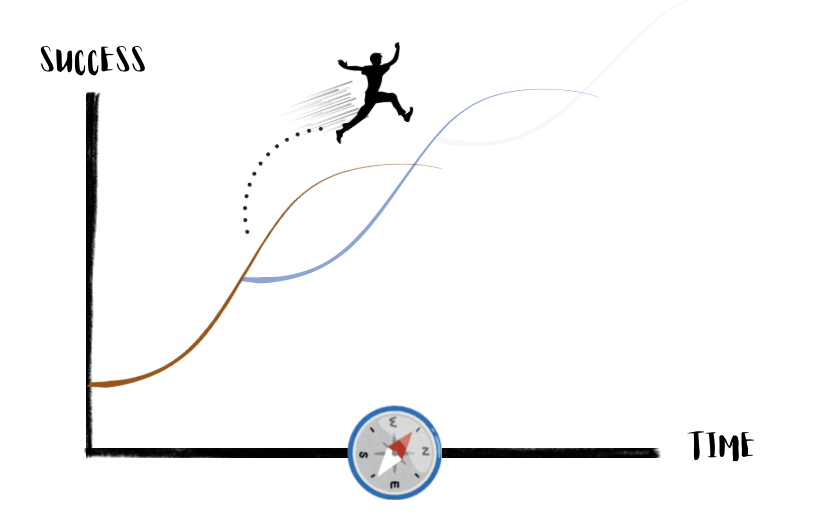
In particular, Charles Handy’s Sigmoid curve model stood out to me because of its ability to integrate continuity and change. Continuity can lead to success, but there comes a point in time when it falters in favour of new phenomena, new ideas. But change should not happen only then. We ought to make it happen before the curve even peaks.
And interestingly, the S-curve model fits perfectly with Studio Dojo’s other domain on Futures Thinking – the initiative to jump off the current curve and preempt the beginning of a new one. More than merely a formula for success, this continuous process of renewals serves as a general compass in navigating life’s ambiguities.
In conclusion…
Change can be intimidating and efforts can feel futile. Yet, meaningful changes do not happen overnight.
It takes courage and an open mind to divert away from the path of least resistance toward confronting heads-on the agency each of us have within our systems.
So, start small with your immediate family or teams, and you never know where that might take you to making greater impacts on larger organisations.