
Understanding the Metacrisis
Sharon joined Studio Dojo as a mid-life intern to learn how Futures Thinking works in practice, not just theory. What she learned went beyond initial curiosities, particularly how the Studio’s four disciplines work together. It prompted deeper questions about the human condition in complex world systems.
Central to this was discovering the Metacrisis—a dynamic where greater understanding doesn’t diminish its ramifications. This article reflects that learning and, perhaps, a small step toward dismantling entrenched worldviews and, if she can’t break them, at least weakening the bonds of systems that perpetuate them.
When everything feels wrong, everywhere, and all at once.
Did you know:
- Six of the nine planetary boundaries – critical indicators of Earth’s health – have passed dangerous thresholds, threatening global stability.
- All of Earth’s energy resources, Oil, Natural Gas, and Coal, will run out in 38, 48, and 100 years, respectively. (Formed over millions of years, none of these are renewable. Alternative energy isn’t scalable. Yet.)
- Human sperm counts have declined by 1.2% since the early 1970s, accelerating to 2.6% since 2000 with an overall decline of 51.6% in 45 years. At this rate, natural human conception could be impossible in 125 years.
Knowing this, how does it make you feel?
What larger story patterns do these crises tell? And what might it mean for our Futures?
State of the Now: Unpacking the Metacrisis
The world is at a tipping point where multiple crises—climate change, political division, economic inequality, and declining mental health—converge and amplify one another in complex ways. These are not isolated issues but symptoms of a larger phenomenon: the Metacrisis—an underlying dynamic that drives a compounding web of crises, threatening large-scale collapse.
At Studio Dojo, we believe addressing the Metacrisis requires more than just action; it requires a fundamental shift in how we understand and approach challenges – large, small, and the extremely wicked.

From Permacrisis to Polycrisis…
To start, it is helpful to consider the types of crises and their relationships.
- The Permacrisis is a long-lasting, continuous cycle of catastrophic events with no end in sight. These are crises so complicated that we can’t predict their outcome. In their persistent state, we can only manage but not resolve; attempts to fix them can sometimes lead to even worse outcomes. Examples of these can be found in recurring climate disasters that bring nonstop floods, disease and deadly heat. Or the rise of cybercrime—now the world’s third largest economy, more profitable than the global trade of all major drugs combined.
- The Polycrisis refers to multiple interlinked crises from different domains (e.g. ecological, economic, social, political) that occur together and worsen each other, creating greater harm than their lone impacts. This interconnectedness creates dilemmas and vicious cycles with consequences that only emerge much later.
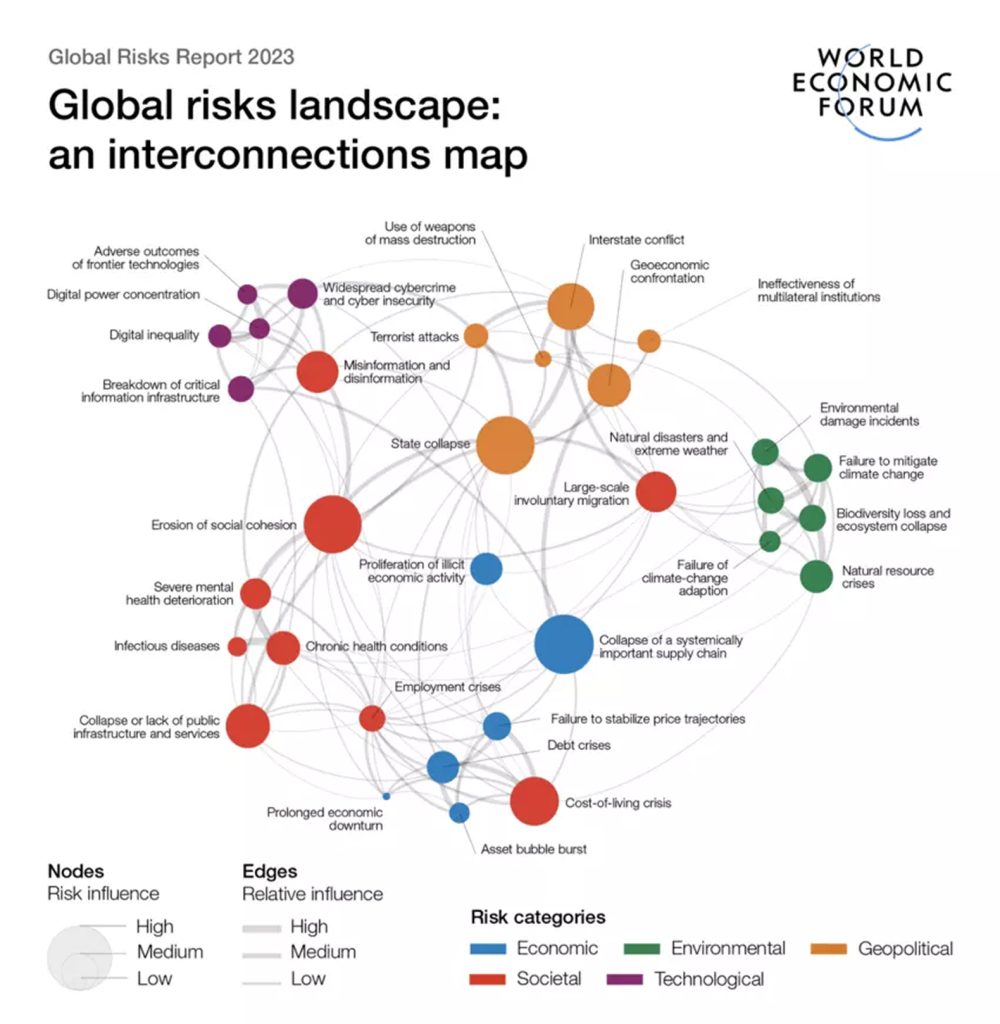
Systemic interactions: how Permacrisis affect each other to become Polycrisis
…Making Sense of the Metacrisis
While the Polycrisis refers to interconnected “world systems of systems”, the Metacrisis goes deeper—focusing on the underlying factors that drive different crises. It looks at the social dynamics and psychological experiences of crises.
“Meta” here means “inner”, “between”, or “beyond”. The Metacrisis highlights the human experience—how we feel and how crises affect us. It represents both the inside of the Polycrisis and the implications of the Permacrisis.
Jonathan Rowson, a leading thinker on the Metacrisis, emphasises its spiritual features (referring to human experience and worldview, not religion):
“Poly gives us a lot, but it does not give us Meta’s interiority or relationality, which is where all hope engendered by meaningful action at the level of civil society lies (action gives rise to hope, not vice versa).”
Source: Perspectiva
This internal dimension explains why the Metacrisis feels so personally distressing. We are experiencing a “crisis of meaning”. As our values and beliefs shift and trust in institutions erodes, we become insecure and anxious about our future.
Navigating Choppy Waters

What can we do? First, we must recognise that the feelings crises evoke are normal and even necessary. While distressing, the dystopian future we fear is often a used future (Sohail Inayatullah, 2008)—an unconsciously borrowed future we can choose to reject. We can make better choices. We can plan and prepare for our preferred futures.
Second, what we need is not only action, but the power to create context. The issue isn’t a lack of data or scientific knowledge—we already know enough. What’s missing is the confidence and emotional safety to act on what we know to be true.
While the Metacrisis cannot be easily “fixed”, we can cultivate anticipatory skills and resilience. These capabilities form the foundation of our work at Studio Dojo. It is why our practice is guided by four disciplines that help individuals and organisations reclaim agency and build meaningful and practical pathways.
Four Disciplines to Surf Over Waves
Futures Thinking
We use Futures Thinking to bring out pluralistic futures, make sense of change, and shape preferred futures. By imagining alternative futures, we influence our present perception, gaining agency and the skills of anticipation and imagination to tackle the Metacrisis.
Design Thinking
Design Thinking takes a participatory approach to creative problem-solving that places complex challenges at the centre of human needs, ensuring inclusivity for all. Through both divergent and convergent thinking, we are better positioned to bridge the human-nature separation driving the Metacrisis.
Organisation Development
Addressing the metacrisis requires seeing entire systems and their interacting elements—not just the parts. Organisation Development helps us understand and work through human systems we are a part of, revealing the hidden dynamics often overlooked in other disciplines. This perspective enables us to effectively respond to layered challenges.
Leadership Development
The smallest unit of change is the individual. Navigating complexities of the Metacrisis requires resilience, adaptability, and the ability to embrace uncertainty. By cultivating self-awareness and growth, we are empowered to create ripple effects in our circle of influence to inspire collective action.
Moving Forward
To address the Metacrisis, we must ask two questions:
Long-term:
“What are our preferred Futures?”
Short-term:
“What do we do next?”
As our understanding deepens and mindsets shift, we begin to ask:
Of what stories do I find myself a part of?
The Metacrisis is simply too heavy to face alone. Our experience shows how collective discussions inspire and strengthen efforts. Through community, we not only share emotional and intellectual burden but also gain diverse insights, creative solutions and caring, mutual support. It is through connection that we can co-create the stories and futures we do want.
Further Reading and Resources
Watch: An introduction to the Metacrisis, Daniel Schmachtenberger; More
Listen: Related Podcast channels, The Consilience Project
Read: Understanding different crisis types, Jonathan Rowson/ Perspectiva
Explore: Metacrisis Meta-Resource, Kyle Kowalski/ Sloww